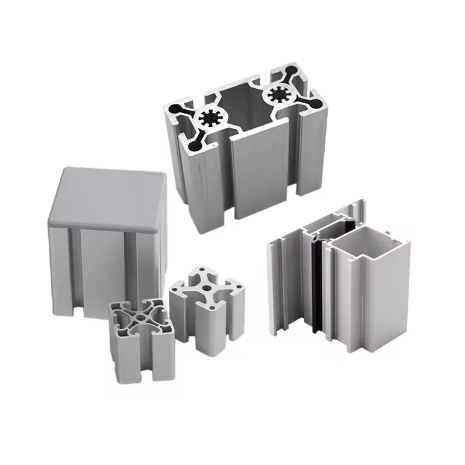
| Basic Characteristics of Aluminum Profiles | Features of Aluminum Profiles | Main Application Areas of Aluminum Profiles |
| Light weight | Aluminum has a density of 2.7g/cm³, about 3/1 that of copper or iron, making it a good material for lightweighting. | Used in the manufacture of aircraft,spacecraft, rail vehicles, automobiles, ships, bridges, high-rise buildings, heavy machinery components and lightweight containers, etc. |
| Good strength | The mechanical properties of aluminum profiles are not as good as steel, but it is high strength, you can add copper, magnesium, maganese, zinc, silicon and other alloying elements, made of aluminum alloy profiles, and then through the heat treatment, and get a very high strength; aluminum profiles of the specific strength of the better than ordinary steel, but also can be comparable to the special steel. | Used in the manufacture of bridges, airplanes, pressure vessels, containers, building structural materials, small hardware, etc. |
| Easy processing | Aluminum profiles have excellent ductility and are easy to extrude hollow aluminum profiles with complex shapes and are suitable for stretching and other cold thermoplastic forming. Aluminum profiles are used as frames for stressed structural components, general merchandise, containers, optics, and other products. |
Structural components and frames subject to stress, general suppliers and various containers, optical instruments and other precision parts with complex shapes, and various construction profiles. |
| Aesthetically pleasing and suitable for a variety of surface treatments | Aluminum and its aluminum profiles have an oxide film on the surface, which is silver-white and quite beautiful; if it is oxidized, the oxide film on the surface is more solid, and it can also be colored and sprayed to create a variety of colors and glossy surfaces. | Architectural wall panels, appliance decorations, ornaments, signs, doors, windows, curtain walls, automobile and aircraft skins, instrument housings, and indoor and outdoor decoration material, etc. |
| Good corrosion and weather resistance | Aluminum profiles do not corrode many substances because the surface generates a hard and dense oxidized film; different alloys are choosed for use in industrial and coastal areas, and will also have excellent durability. | Door panels, vehicle and ship exterior coverings, kitchen appliance, chemical fixtures, roofing shingles, power washers, seawater desalination, chemical and petroleum products, packaging materials and chemical packaging, etc. |
| Chemical resistance | Non-reactive to chemicals such as nitric acid, glacial acetic acid, H2 peroxide, etc., with very good drug resistance. | Used in chemical installations, packaging and packaging of acids and chemicals, etc. |
| Good thermal and electrical conductivity | Thermal conductivity, electrical conductivity is second only to copper, about 3-4 times as much as steel. | Electric wires, busbar connectors, pots, rice cookers, heat exchangers, car radiators, electronic components, etc. |
| Good reflectivity to light/heat/electric waves | Reflectivity of light is 70% for polished aluminum and 94% for high-purity aluminum after electrolytic polishing, which is higher than that of silver (92%); aluminum also has good reflective properties for thermal radiation and electric waves. | Insulation for lighting, reflectors, roof tiles, parabolic antennas, refrigerators, freezers, light projectors, heaters, and coolers. |
| Non-magnetic | Aluminum is non-magnetic. | Compasses, antennas, wheelhouse instruments, etc., for use on ships. |
| Non-toxicity | It is non-toxic, and the amount dissolved when it comes into contact with most foodstuffs is very small; at the same time, because the surface is smooth and easy to clean, it is not easy for bacteria to stay and multiply. | Food utensils, food packaging, fish tanks, fish storage, medical equipment, food containers, food machinery. |
| Absorption | Profiles are non-transmissive to sound and have the property of absorbing sound waves. | For indoor ceiling panels, etc. |
| Low temperature resistance | Low-temperature-resistant aluminum profiles are ideal for low-temperature installations because their strength increases at low temperatures without brittleness. | Cold stores, freezers, Antarctic snow vehicles, oxygen and H2 production units. |
